
Financial possibilities for future antibiotics
Antibiotics presently on the market have low cost as they are old and without patent-protection. Society at large thus expects also new antibiotic drugs to be cheap. This is one of the major reasons for Big Pharma to avoid prioritizing development of new antibiotic drugs – it has simply not been profitable. There are several initiatives intended to make development of new antibiotic drugs profitable again. But the most important reason is that it will be profitable for society to reduce gastric cancer and Alzheimer's by eliminating H. pylori infections and resistance development will require many new antibiotics.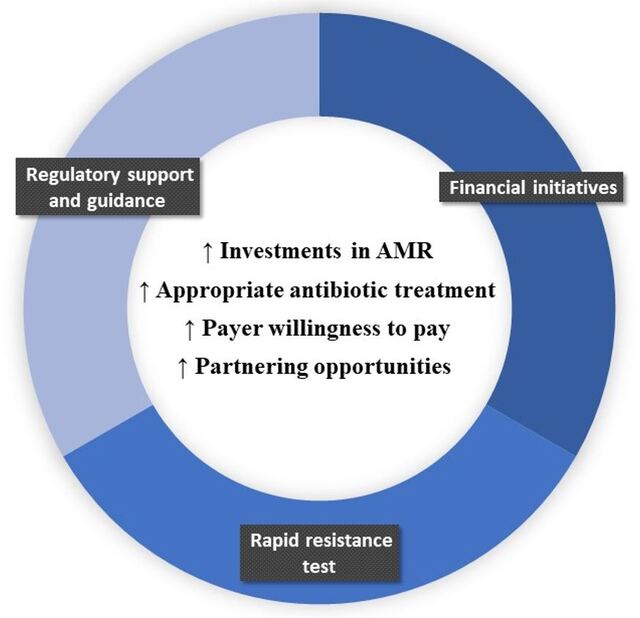
Financial incentives One recent opportunity is the AMR Action Fund which was presented in July 2020. Several Big Pharma, WHO, The Development Bank, Wellcome Trust, Bill and Melinda Gates Fund and others have created this fund, which will invest 1 billion USD during 5 years to support clinical development of novel antibiotics. The AMR Action Fund will initially invest in 15-20 projects. Investments will be via equity stake or equity-like securities and the AMR Action Fund will provide companies with access to capabilities and expertise. The goal is that its investments should result in 2-4 new antibiotics by 2030.
Another possibility is a new financial model for companies developing new antibiotics, as proposed in the DRIVE-AB Final Report. This model is composed of “push” and “pull” incentives including market entry rewards of 1 billion USD.
Two examples of "pull" incentives are Transferable Exclusivity Extension (TEE) and subscription models. TEE could be a way to make Big Pharma interested in new antibiotics as this could prolong patents on other products. Subscription models would be based on offering antibiotic developers upfront payments in exchange for access to their antibiotics, and this type of model is a central part of The PASTEUR Act. Beam Alliance has proposed pull incentives mechanisms including both TEE and subscription models.
Rapid diagnostic tests Further, technical development of rapid diagnostic methods for determination of the susceptibility of pathogenic bacteria to antibiotic drug may prove crucial to make new antibiotics profitable again. New technology for rapid (15-30 minutes) susceptibility determination of active bacterial infections in clinical settings is likely to come. When in place, it will enable the selection of the best antibiotic treatment from the start, even if this treatment may be highly priced. This practise will save lives when it comes to patients with life-threatening systemic infections. This will make it possible for pharmaceutical companies to develop new antibiotic drugs, and to cover the very high developmental costs. Rapid diagnostic tests can also be used by asymptomatic persons to identify if they carry H. pylori and then have the option to get rid of this pathogen.
New and very large markets for antibiotics as cancer prophylaxis, by H. pylori removal, is the best financial possibility for new antibiotics, as described in New Markets. Removal of H. pylori will also reduce risk for Alzheimer's disease and Parkinson disease. The Ultupharma project ULT2 provides several new antibiotics active against H. pylori.